
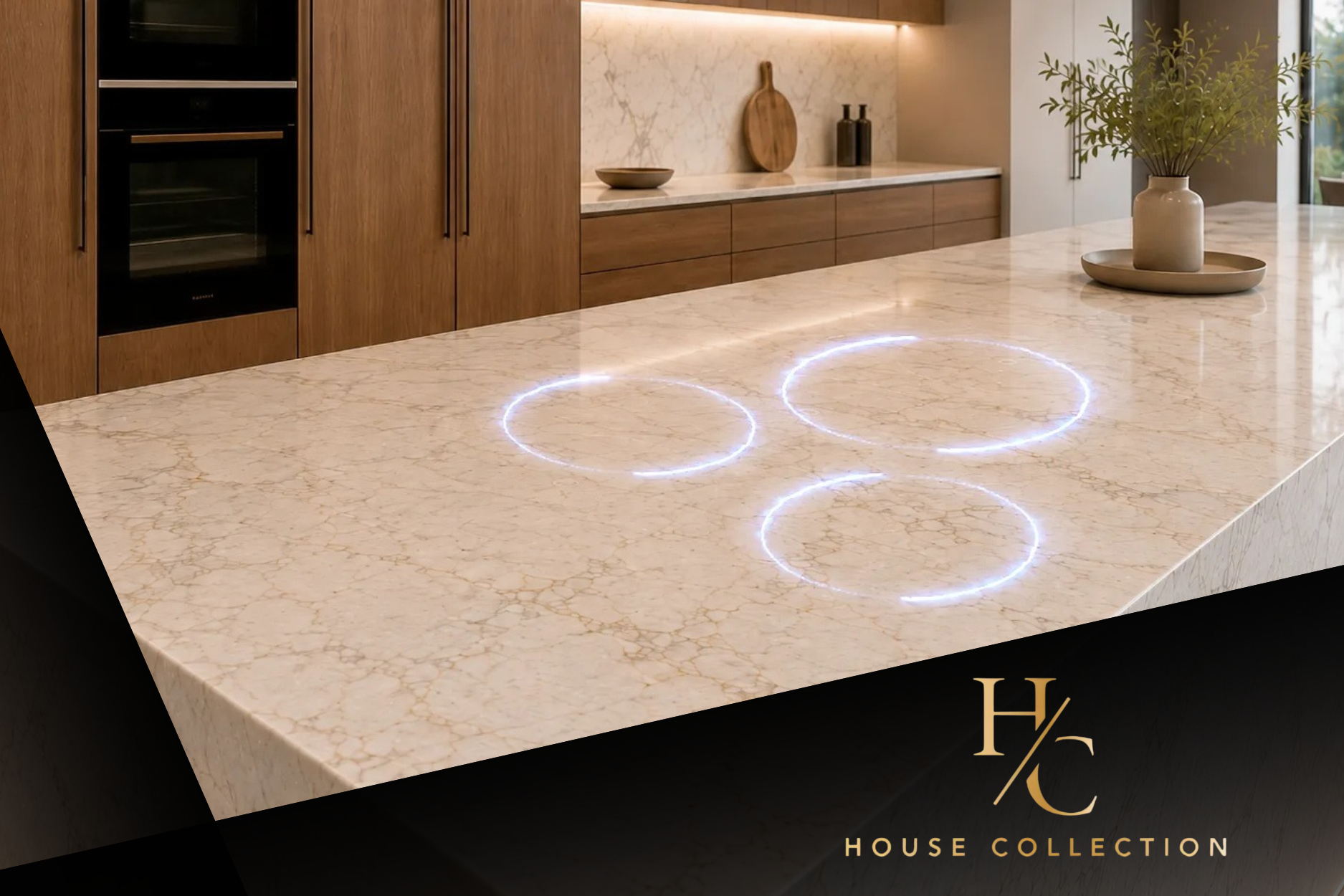
Cloen: Kitchen Technology Hidden Beneath the Worktop
A cooking hob no longer has to interrupt the worktop's visual continuity. Cloen introduces new possibilities for kitchen layouts, integrated functions and material-led design.
Kitchen technology is increasingly becoming part of the architecture rather than remaining a collection of separate visible appliances. Cooking equipment can now be integrated within worktops, cabinetry and material surfaces, allowing the design to take precedence. Spanish technology company Cloen develops induction systems that move cooking functions beneath the worktop, introducing new possibilities for contemporary kitchen planning.
Cloen: Rethinking the Relationship Between Cooking and Design
Cloen is a Spanish technology company specialising in induction cooking, wireless energy transmission and integrated kitchen equipment. Its approach is based on a clear principle: cooking functions do not necessarily need a conventional visible hob to operate.
The manufacturer develops induction modules installed beneath compatible porcelain worktops. Electromagnetic energy is transferred to the cookware through the material, enabling cooking without introducing a separate hob surface.
This changes how appliances can be integrated into the kitchen. When cooking is not taking place, the worktop maintains a more continuous architectural appearance, particularly valuable in projects where the kitchen island becomes a central element of the living space.
Invisible Induction: Cooking Directly on Porcelain
Cloen invisible induction places the cooking modules beneath the worktop. Unlike a conventional induction hob, the cooking area does not require a separate visible glass-ceramic panel.
The manufacturer develops systems designed for compatible 12 mm porcelain worktops, subject to the installation and material requirements of each platform. Energy passes through the surface to heat suitable cookware, while the electronic system manages operating conditions.
For interior designers, this creates an important compositional opportunity. A single surface can support food preparation, cooking and other everyday activities while retaining its architectural identity.
However, a seamless worktop does not eliminate technical requirements. Cooking zones still have defined positions, and the system requires suitable cookware, appropriate ventilation and installation in accordance with the manufacturer's documentation.
These considerations are particularly important when incorporating invisible induction into made-to-measure cabinetry and large kitchen islands.
Original, Advanced and Horizon: Different Induction Configurations
Cloen offers several invisible induction platforms, each designed around different cooking arrangements and functional requirements.
Original. This platform combines three cooking zones, two of which incorporate dual technology for both induction cooking and wireless energy transmission. It brings these functions together beneath a continuous worktop without the need for a visible hob.
Advanced. This family includes two-, three- and four-zone configurations, combining Dual Induction with additional features such as Flex cooking zones. Compatible areas can be combined to accommodate certain larger cookware formats.
Horizon. This platform focuses on modular cooking arrangements. Its three independent induction modules offer flexibility when positioning cooking areas across the worktop. Unlike the dual configurations of Original and Advanced, Horizon does not provide wireless power transmission for small appliances.
For professional specification, the appropriate choice depends on how the kitchen will be used, the position of preparation areas and the functions required at each point of the worktop.
Dual Induction: Cooking and Wireless Power on One Surface
One of Cloen's most distinctive technologies is Dual Induction, which brings conventional induction cooking and wireless energy transmission together in specially designed zones.
The system can support cooking vessels and small appliances developed to receive energy directly from the worktop. Compatible devices do not require conventional power cables or internal batteries to operate.
For example, a compatible blender can function when correctly positioned over a dual zone, while another cooking area remains available for preparing food.
This technology can reduce visible cables around the cooking area and introduces a different way of organising small kitchen appliances.
Importantly, wireless power transmission is specific to compatible Cloen devices. It should not be interpreted as a universal system capable of powering any electrical appliance placed on the worktop.
Material Continuity: Making the Worktop the Main Design Element
Invisible induction is particularly relevant in kitchens where the worktop material plays a central architectural role.
In open-plan interiors, conventional hobs introduce a visible interruption that can affect the appearance of a kitchen island. By positioning the induction modules beneath the surface, Cloen allows the selected material to remain visually continuous.
This approach can be considered for stone-effect porcelain, restrained neutral surfaces or worktops with pronounced veining, provided that the selected material meets the technical compatibility requirements.
It is equally relevant for multifunctional islands where food preparation, cooking and social interaction take place around the same architectural element.
The visual benefits must be balanced with clear identification of cooking zones, safe operation and appropriate care of the worktop, including precautions concerning residual heat.
Control Freedom: Integrating Controls into the Kitchen Design
Designing a kitchen with invisible induction also requires careful consideration of the control interface.
Cloen's Control Freedom concept offers different integration possibilities, including horizontal and vertical controls, drawer-mounted solutions and flush-mounted interfaces.
These options allow the control position to be coordinated with cabinetry design, taking into account ergonomics, visibility and ease of access during cooking.
For architects and interior designers, this flexibility can be valuable when creating kitchens with minimal visual interruptions.
However, compatibility between the selected control arrangement and induction platform must be verified before confirming furniture manufacturing, worktop machining and electrical connections.
What Should Professionals Consider Before Specifying Cloen?
Installing an invisible induction system requires early coordination between the worktop supplier, cabinet manufacturer and equipment installer.
1. Select the induction platform and determine the number, size and position of cooking zones according to the intended use.
2. Confirm porcelain compatibility, thickness and the preparation and installation conditions specified by the manufacturer.
3. Coordinate the available space beneath the worktop with cabinet construction, ventilation, electrical connections and maintenance access.
4. Verify cookware requirements and wireless appliance compatibility, distinguishing Dual Induction platforms from systems designed exclusively for cooking.
5. Define the control interface and review operating and safety instructions, including precautions relating to residual heat within the worktop material.
Addressing these points during the design phase helps avoid conflicts between equipment, surfaces and cabinetry once the kitchen is manufactured.
Cloen at House Collection: Technology as Part of Kitchen Architecture
Cloen is part of the House Collection brand selection, a Barcelona-based B2B platform for architects, interior designers and professional specifiers.
Its invisible induction systems provide an opportunity to explore kitchen solutions in which worktop materials, cooking equipment and spatial planning are considered as part of a coordinated design.
Through House Collection, professionals can explore Cloen technology and evaluate which platform and configuration best meet the functional, technical and aesthetic requirements of their projects.
FREQUENTLY ASKED QUESTIONS
What is Cloen invisible induction?
It is a cooking system that installs induction modules beneath a compatible porcelain worktop, allowing cooking without a conventional visible hob.
How does Cloen Dual Induction work?
Dual Induction combines cooking and wireless energy transmission in compatible zones. Specially designed small appliances can receive power directly from the surface without cables or batteries.
What is the difference between Cloen Original, Advanced and Horizon?
Original combines three cooking zones, including two dual zones. Advanced offers dual configurations with additional functions such as Flex. Horizon uses independent induction modules without wireless appliance power transmission.
Can Cloen be installed beneath any worktop?
Universal compatibility should not be assumed. Cloen develops systems for compatible 12 mm porcelain worktops, but the selected material, thickness and installation requirements must be verified.
Can conventional pots and pans be used with invisible induction?
Cookware must be suitable for the system. Cloen provides specific recommendations and cookware solutions for invisible induction, which should be reviewed before selecting cooking utensils.
What should professionals consider before installing Cloen?
Key considerations include worktop compatibility, cooking zone layout, ventilation, electrical connections, cabinet clearance, maintenance access and the manufacturer's installation and safety instructions.